In their capacity as medical professionals and volunteers, members of the UIAA Medical Commission have provided frontline support throughout the Covid-19 pandemic. On behalf of the UIAA, they have also provided valuable support to the dedicated UIAA Covid-19 Taskforce and have worked on literature to provide mountain users with the best possible advice.
Last year MedCom members contributed to the first paper to tackle the subject of Covid-19 and the potential risks of outdoor sports. In May 2021, Commission member David Hillebrandt (former Commission President) and guest author Piotr Szawarski published an advice paper titled ‘Adventure Travel and the Covid-19 Pandemic’. It is intended for persons and organisations who are planning trips in the Covid era.
As the paper’s abstract outlines:
In the modern world local and international travel was taken for granted and this has enabled the adventure travel industry to thrive. This concept is now threatened by the Covid-19 pandemic. Many individual mountaineers and those in the industry see the pandemic in simplistic terms and do not appreciate the many additional risks that have to be taken into account when planning a trip. Our medical knowledge of the SARS-CoV-2 virus is constantly evolving so this advice paper has applied the general principles of travel and expedition medicine to give insight into the many varied medical and political risk factors to be considered when planning any venture.
The paper then looks at the subjects of impediments, risks, mitigation and crisis before drawing some general conclusions.
There is also an annex in a table form of considerations with regards to feasibility of adventure travel under pandemic conditions.
The paper, currently in English, can be downloaded here.
The webinar will centre around a documentary on the late Ueli Steck. The ‘Swiss Machine’ was one of the climbing world’s most emblematic figures. A two-time Piolet d’Or winner, Steck was revered for his speed records.
On 30 April 2017, Steck, 40, died after falling during a solo climb on Nuptse (Khumbu, Nepal). Extracts from the film Memories of an Exceptional Mountaineer (in German with English subtitles), which charts the impact of Steck’s death on his family, debates the inherent rinks climbers take as well as first-hand testimonials from those who accompanied Steck on his climb, will be shown during the webinar. There will also be a Q&A panel discussion featuring friends, climbers, filmmakers and delegates from UIAA Commissions.
The film is written by Jacqueline Schwerzmann who accompanied Ueli Steck throughout his career and in this biographical film she puts the person behind the well-known mountain climber in the foreground.
Panellists will include:
Ueli Bühler, Switzerland, close friend
Amit Chowdhury, India, UIAA Executive Board and former Safety Commission President
Sam Gyger, Switzerland, one of the filmmakers
Sofie Lenaerts, Belgium, 7-summiter
Mrika Nikci, Kosovo, UIAA Youth Commission member and youngest female 7-summiter
Christian Trommsdorff, France, former International Federation of Mountain Guides Association (IFMGA) President, Piolet d’Or organiser
The webinar will take place on Saturday 29 May (14:00-15:30 CEST). Check your timezone here.
The UIAA – International Climbing and Mountaineering Federation – Management Committee (MC) held its second online meeting of 2021 on 1 May. It was followed, as is now custom, by a meeting of the Executive Board, MC and UIAA Commission Presidents.
MANAGEMENT COMMITTEE
Following an opening address by UIAA President Peter Muir, Françoise Jaquet, UIAA Treasurer, detailed the UIAA’s financial result 2020 for General Assembly recommendation before presenting the first 2021 budget forecast.
One of the more significant agenda items was an update on the progress made by working groups (WGs) created by the Executive Board late in 2020. These WGs have been set up to review different areas of the organsiation including external and internal relations, governance, finance, communication and commissions. Highlights of progress to date – establishing a list of all existing UIAA external relationships and defining a hierarchy of contacts; aligning the UIAA organisational structure more closely with its Articles of Association (AoAs); setting the budget planning process for 2022 and standardising financial reporting; supporting Commissions in mapping their goals and contributing to the evolution of the UIAA Strategic Plan; empowering UIAA continental representatives to work even more closely with membership in their respective regions and defining the UIAA Communication Plan for 2021.
UIAA General Secretary Lode Beckers provided a reminder about the guiding objectives of the Strategic Plan 2021-2024 and the next steps which include: ensuring these objectives are both embodied in projects of UIAA Commissions and as one of the determinants for the aforementioned WGs; making sure the implementation process will be elaborated on in conjunction with MC members, Commission Presidents, EB WGs and other taskforces; and that the subject remains a recurrent agenda item at various levels.
Lode Beckers also presented the continued international guidance offered by the UIAA Covid-19 Committee in terms of climbing and the global pandemic. The dedicated UIAA Covid-19 portal offers regular updates on this taskforce’s meetings and statements.
UIAA Communication Manager Peter Bourne provided an overview of the 2020 Annual Report, the final digital edition is expected to be released in mid-May. UIAA members will be given the opportunity to request a printed copy, scheduled for distribution in June 2021.
The MC also voted on a number of Commission elections and agreed to make a decision on the hosting of the 2021 UIAA General Assembly, whether this will be held online or in-person, no later than early July. Any decision will be taken in close collaboration and full agreement with the organising parties. Commission lists will be updated on the relevant UIAA website pages in due course.
Details of a generous donation made by UIAA Honorary Member Dr Injeong Lee (President of the Union of Asian Alpine Association – UAAA) was announced. Dr Lee has offered the UIAA 10,000 USD to help support the recovery of the worldwide climbing community from Covid-19. The UIAA will communicate shortly on how this contribution will be allocated.
Longstanding MC member Greg Moseley provided an update from the Mountain Club of South Africa (MCSA) where he has recently been succeeded as the federation’s President by Paul Carstensen. The latter joined the MC meeting as a guest. The UIAA congratulates Greg Moseley on the significant accomplishments he has achieved as MCSA President particularly those related to encouraging greater collaboration between climbing and mountaineering organisations in Africa. Equally the UIAA looks forward to working with Paul Carstensen and wishes him every success in the role.
COMMISSION PRESIDENTS
Each of the UIAA Commission Presidents provided a recent recap of ongoing projects.
In-competition doping controls took place at the UIAA Ice Climbing World Cup in Kirov, Russia ensuring that the UIAA, despite the skeleton competition ice climbing season, managed to fulfil its testing obligations. The new World Anti-Doping Agency (WADA) Code has been fully implemented. Dr Andjelkovic was re-elected as Commission President.
The 2020-2021 UIAA Ice Climbing season recently concluded. A number of events, mainly on a regional level, were held. The UIAA also collaborated with the Ouray Ice Festival on the promotion of its January event. One of the focuses of the Commission is developing the sport so it meets IOC targets in relation to entry into the Olympic programme as a fully integrated competition sport. The Commission is also working on recruiting new members with specific skillsets.
MedCom is working hard on updating a number of its recommendation papers, particularly those focused on female climbers. The Commission also recently released its first video recommendation, dedicated to water disinfection.
Much of MountCom’s 2021 focus has been dedicated to the recent creation of a Mountain Worker Initiative (MWI) set up to support improving the treatment and conditions of mountain workers. The MWI group is meeting regularly and a first set of guidelines and recommendations will be further developed in the months ahead.
Access is a Working Group (WG) of MountCom. Juan Jesús Ibáñez Martin’s maximum term as WG Chair came to an end this spring. Milosz Jodlowski from Poland (PZA) was renominated as a Commission member by the MC to succeed him as Chair. The WG’s key mission is to advocate for responsible free access. One of the core projects of this WG is the creation of a database of international access restrictions. Ibáñez Martin’s two decades of work for the Access Commission, now WG, are the subject of the latest UIAA volunteer profile.
Likewise Training is a WG of MountCom. Owing to Covid-19 all onsite training courses are on hold. However, the training database after years of development is now active, has been piloted, and will gradually be rolled out for UIAA members to access. An updated digital version of the Alpine Summer Skills Handbook is due for release imminently.
Legal Experts Working Group (LEWG), Klara Dvorakova
The LEWG has committed to offering regular support to different UIAA Commissions and to the EB, MC and Office. Its work and insights were recently captured as part of an article on litigation in Alpinist Magazine (Issue 73).
The Commission has already held two online meetings this year focusing on updating its project portfolio and more closely assigning different Commission members to supporting core tasks. A reminder that the application deadline for the 2020-2021 UIAA Mountain Protection Award is 31 May.
SafeCom continues to meet regularly online with its main annual plenary session (held with Safety Label Holding manufacturers and UIAA accredited laboratories) scheduled for the end of May. Ten working groups (including those working on avalanche probes and load sharing devices) are currently active delivering a number of valuable research projects. Its online Q&A series published on the UIAA website continues to offer valuable knowledge to climbers. SafeCom is also collaborating with the Ice Climbing Commission on standards related to safe competition structures and clothing.
The next online UIAA Management Committee meeting, organized as always with the support of the UIAA Office, will be held in August. Official minutes will be released to MC members in due course.
Main photo: Credit: Pat Morrow. Courtesy of Alpine Club of Canada
The UIAA – International Climbing and Mountaineering Federation – regularly receives questions related to safety topics. The UIAA Safety Commission, with support of other UIAA Commissions and experts, has published a series of articles answering common questions with the objective of making them available to the wider climbing community.
This month’s question is:
Is there is a recognised procedure to disinfect/clean climbing equipment (such as harnesses, helmets, ropes) other than the usual cleaning process of using mild soap and water? My question is based on the current Covid-19 situation where equipment needs to be disinfected after use in case another climber then uses the same equipment.
UIAA Safety Commission:
This is a difficult topic to give a general answer and the best advise would be to rely on the World Health Organisation’s advise or the manufacturers’ instructions.
Many rope manufacturers offer advice on how to disinfect their ropes, and this advice may differ from one manufacturer to the next. It is therefore very important to always follow the particular method of cleaning recommended by manufacturer.
Below are some links to UIAA accredited manufacturers (Safety Label Holders). Please always follow the manufacturer’s instructions.
Beal
Method 1 – 72hr quarantine. Method 2 – Use Beal Rope Cleaner at 60°C (normally 30°C, so max 10 times!). Method 3 – Submerge the product in Isopropyl or Isopropanol for 30-60 seconds (max 10 times!)
Three options out of quarantine: Dispose or Time (quarantine for at least 72 hours) or Wash (30°C clean domestic grade water with liquid soap in the pH range 5.5 to 8.5 for 15 minutes. Rinse thoroughly. Dry naturally – away from direct heat).
Disinfect in hot water – At least 30 minutes at a temperature of 58-60°C, then air dry avoiding exposure to the sun or heat sources; or Soap wash – 15 minutes in lukewarm water at a temperature of 30-32°C with soap (pH 5.5-8.5) then air dry as above; or quarantine in a well-ventilated area, avoiding exposure to the sun or heat sources, for at leat 7 days.
Step 1 – 72 hour quarantine.
Step 2 – For Polyester and Polyamide products: Wash in a washing machine with natural soap (pH range 5.5-8.5) at 60°C for a minimum of 15 minutes. Place the items inside a protective fabric cover to reduce the risk of abrasion damage, and ensure the washing machine is free from other washing liquid / tablet and softener residues.
– For Dyneema – As above BUT at 30°C.
– For Metallic products can be cleaned using clinical disinfectant wipes or disinfectant. Be aware that Chlorine based chemicals can cause corrosion / cracking of some stainless steel components. Check the ingredients with the manufacturer.
Step 3 – Dry the product following the information provided in the General User instructions.
Protocol 1 – 72 hour quarantine
Protocol 2 – Hand wash with soap and water at a max temperature of 65°C (Warning: these are exceptional measures during the Covid-19 crisis. Otherwise, under normal circumstances, please wash your equipment at 30°C)
Cleaning products developed by ECOLAB, when applied as instructed, are also compatible with all Petzl helmets and can be used (although Petzl do not know to what extent, if at all, ECOLAB’s products are effective in killing or preventing the spreading of the Covid-19 virus).
– Ethanol with the following contents (83% of denatured 95% ethanol, 11.3% of distilled water, 4.2% of 3% hydrogen peroxide and 1.5% of glycerol) BUT not recommended to apply more than 3 times.
– Isopropanol or Isopropyl BUT not recommended to apply more than 3 times.
– Hot water (55°C) For a non-destructive disinfection of your polyamide or polyester gear or metal components. NOT applicable for gear made of HMPE (Dyneema, Spectra, Dynex or similar).
– Hand soap with a pH range 5.5 – 8.5 for at least 15 minutes in 30°C water.
– Air dry in a well-ventilated place away from all sources of heat for at least 1 week.
Ropes can be disinfected by being submerged in a solution of 70% Isopropanol and 30% Distilled water for three (3) minutes maximum. Air dry naturally away from heat sources or direct sunlight. Disinfection should be done when needed and not daily. A qualified inspection of the rope is mandatory.
Ask UIAA SafeCom
To submit a question to be addressed by the UIAA Safety Commission please click here.
For over 21 years, Juan Jesús Ibañez Martin (FEDME, Spain) has supported the UIAA as a volunteer primarily lending his expertise in the field of access. Joining the Access Commission in 2000 he has risen through the ranks from full member to secretary and more recently as President of the now Working Group which forms part of the Mountaineering Commission. At May’s UIAA Management Committee meeting, Ibañez Martin’s eight-year term came to an end with Milosz Jodlowski from Poland (PZA) renominated to the Commission and elected as the new WG Chair. Ibañez Martin shares his reflections of his time as a UIAA volunteer.
UIAA: When did your involvement with the UIAA begin? Juan Jesús Ibañez Martin: In early 2000 the new Access and Nature Commission of FEDME was created and I was elected on behalf of the mountaineering and climbing federation of Asturias, my region. During subsequent discussions, we agreed that FEDME had to be linked with the work, ideas and common path followed by other national federations. It was decided that FEDME would ask to join the UIAA Access and Conservation Commission, and that I would be the FEDME delegate.
How did you first come to hear about the UIAA? During the aforementioned FEDME meeting I heard for the first time about the UIAA, as the international federation. Back in the Asturias I talked to some friends, mountain guides and huts owners to discover more about the UIAA. After all, access to the internet was not so easy at the time. Thanks to their input, I started to have a global idea about the UIAA.
In what capacity do you support FEDME and for how many years have you done so? I started to collaborate with the FEDME Access and Nature Commission in 2000 and over the years, my involvement was gradually increased until the beginning of 2009 when I became a part time worker of FEDME linked with their area of Access and Nature. The situation has changed significantly this year in which I have assumed the coordination of international relations of FEDME as well as the technical coordination of the entire social area as a full-time professional. I am also a private tutor in maths, chemistry and physics.
2006 UIAA Access Commission meeting in Huascaran, Peru
When did your relationship with the Access Commission begin and what led you to become its President? In June 2000 I was coming home from a meeting with some mountain huts owners of the Asturias when I received a phone call from FEDME, confirming that I had been admitted as member of the UIAA Access and Conservation Commission. I would attend my first meeting the next day in Pralognan la Vanoise, France.
After a tortuous trip I finally met the members of the Commission who were waiting in the hotel for the arrival of the new Spanish delegate! I was very lucky to have the opportunity to learn from some real experts in the field. Robert Pettigrew (Commission President at the time) welcomed me together with members who are sadly no longer with us like Daniel Taupin and Stefano Tirinzoni.
Step by step, discussions, ideas, and the path of the Commission followed a clear vision: to expand the idea of free and responsible access. Year after year the group continued to do good work with a strong balance between supporting member federations and producing important works such as the Argeos Charter.
In 2009, during the Plas y Brenin MC meetings President Pettigrew stepped down after serving his maximum two terms and Clare Bond (BMC) was elected as new President of the Commission. I was elected as Secretary for the upcoming four years. In that period, led by Clare, the Commission worked intensively but due to her added responsibilities, during the Access Commission meeting in Stockholm (2013) I was elected as President of the Access Commission. I was re-elected in 2017 in Bern with my term having recently ended.
What achievements are you most proud of having achieved with the Access Commission? The Climbers’ Manifesto is a remarkable document with a huge history of work, collaboration from different people, thoughts and, in fact, a clear demonstration that UIAA members can work together for a clear objective, such us with the recent Mountain Workers Initiative. I’m very proud of being able to transmit to UIAA members the need to work together and support among us to promote a free and responsible access to the mountains.
How has the Access Commission/Working Group’s mission evolved during your time supporting it? For me it was important to understand that issues are no isolated cases or a problem solely for the areas directly impacted. I think we have been able to transmit to all members that together we can successfully support each other.
2018 UIAA General Assembly, Mongolia
What do you believe are the main challenges UIAA members currently face in terms of access restrictions/questions? In recent years people have increased their interest for visiting nature, we can see it when we visit the most popular mountain destinations, this effect has been amplified due to the current pandemic situation. There is an increased risk of ‘massification’ in some places that, for us, can be problematic if restrictions are placed on our activities. But I’m convinced that we can continue to convince environmental authorities that the solution should not be to prohibit access. For us mountaineers, climbers, hikers, we don’t need a parking area at the top of a valley or close to a waterfall. These infrastructures should be close to villages to support the local communities and the nature areas themselves left unspoilt for people to explore responsibly.
In terms of your interest in climbing and the mountains, when did this begin? What are your primary mountain-based passions today? My connection with the mountains was born very early on due to the fact that my homeland, the Principality of Asturias, is a mountainous paradise in the north of Spain. I started to attend the weekly mountain activities of my school club at the age of six. Later I practised different activities – hiking, climbing, skiing, summer camps, guidance courses and camps, in the Asturias, the nearby Cantabrian range, the Pyrenees, and the Alps.
My passion was and is hiking and alpinism although in recent years I have combined that with skyrunning where I am specialised as an environmental referee, an important role for competitions held in nature.
What is your favourite place in Spain to climb/hike/visit, and what is your favourite mountain destination worldwide? Born and living in the Principality of Asturias (North of Spain) it’s very easy for me to tell you that, Asturias. The area has everything in terms of climbing and hiking. The north of Tenerife is also a paradise for hiking. Worldwide? It’s very difficult to say just one place. Of course the Alps, in the winter and summer. Generally speaking, I like long routes where you can learn from the people in the villages, about their lives and their history.
What have you most enjoyed about being part of the UIAA? I have enjoyed the chance to meet such incredible group of people (and become friends), from different places, countries, customs, ideas and all working in the same direction for a common passion.
What are your other hobbies? I like to travel, discovering new places, peoples, customs (not necessarily far from Spain), sometimes little villages inside my country are a fantastic experience full of remarkable moments, especially if the trips are done with friends. I love to read, especially in calm moments (I haven’t much of these in recent times!) and listen to music. Until not too long ago I used to sing in a choir, here in Asturias, which has given me the opportunity to learn more about some of the most beautiful pieces of the history of the music. I really hope to sing more in the future but other demands have taken precedence.
Do you hope to stay involved with the UIAA in the future? Of course. I hope to continue serving the UIAA on behalf of FEDME to share the knowledge I learnt during recent years.
Earth Day, created in 1970, is an annual event held on 22 April to raise awareness about the importance of environmental protection. Today it is a global movement with initiatives and events taking place internationally.
The UIAA Mountain Protection Commission (MPC) marked the day by participating in a Mountain Women of the World webinar, led by a transnational network of mountain women. During the session, mountain women from around the world including three members of the MPC – Dr Carolina Adler (New Zealand), Professor Harshwanti Bisht (India) and Aupar Ahmed (Bangladesh) – shared their experiences and knowledge.
The MPC enjoys a close partnership with the United Nations Environment Programme (UNEP). The United Nations General Assembly proclaimed 22 April as International Mother Earth Day through a resolution adopted in 2019. The Day recognises the Earth and its ecosystems as humanity’s common home and the need to protect her to enhance people’s livelihoods, counteract climate change, and stop the collapse of biodiversity. The theme for 2021 is Restore our Earth.
As UNEP writes ‘Mother Earth is clearly urging a call to action. Nature is suffering. Australian fires, heat records and the worst locust invasion in Kenya. Now we face COVID -19, a worldwide health pandemic link to the health of our ecosystem. This International Mother Earth Day, we need a shift to a more sustainable economy that works for both people and the planet.’
Learn more about UNEP’s work on halting the degradation of ecosystems and climate change:
UIAA President Peter Muir sent his own message to UIAA members worldwide:
Dear Members
Happy Earth Day!
I hope this message finds you safe and well.
Despite current troubles, Earth Day this year seems an especially important reminder that Earth is both a wonderful provider of resources for our passions but also, like any home, a sensitive trust requiring our care and respect.
I hope you and your members can spend one of the three Earth Days (April 20 -22) outside enjoying her bounty while reflecting on the small and larger steps we can each take to reduce our environmental impact.
Keep safe and keep yourself and Earth as well as you can,
Peter Muir, UIAA President
Main photo: Credit, Tristan Rasumssen. Courtesy of Alpine Club of Canada
The UIAA Taskforce set up to offer guidance to the climbing community throughout the Covid-19 pandemic held its most recent online meeting on 24 March.
Discussions centred on the subject of vaccination roll outs, the impact of third waves in certain countries and recommendations to the UIAA Management Committee regarding the staging of in-person meetings later this year including October’s General Assembly. Across the world and UIAA membership, the situation is very different ranging from a gradual easing of phased lockdowns in some areas to a return to full lockdowns and curfews in others. With this in mind it is difficult for the UIAA to provide general global advice other than reminding climbers and mountain visitors to respect the rules and regulations published in their specific countries and regions.
Regarding climbing and mountaineering activities, the following regional updates were provided by different member federations:
Belgium, CMBEL (Climbing Mountaineering Belgium)
Indoor sports: Not currently permitted, the exception being some professional competitions. No indoor climbing halls are open and gyms remain closed.
Outdoor sports: Cycling, hiking, walking are permitted. Group activities are restricted to five individuals. Outdoor rock climbing is strictly regulated, registration necessary. Some safety regulations need to be observed (masks, distancing, access travel, no overnight stays in tents, no barbecuing). Huts are closed. No youth camps are being held and climbing school programmes by clubs are on hold. For detailed updates: www.kbfvzw.be, www.clubalpin.be, and www.cmbel.be.
Germany, DAV (German Alpine Club)
The restrictions with regard to mountaineering and skiing are quite severe. All ski stations are closed. Ski mountaineering is still permitted, skiers are required to respect regulations for social distancing. The number of people who visit the mountains on weekends is extremely high. It is the main escape for people from the stress of working from home. Hotels and restaurants are closed. Tourism within Germany is severely restricted.
All climbing gyms are closed and will not reopen before the end of April or even later. All huts are closed as well. Travelling to some neighbouring countries is restricted to quarantine regulations which define that even for a short trip (a few hours) to Austria, people are obliged quarantine for five days when (re)entering Germany. Considering the above the DAV has decided to recommend that its members should continue to respect lockdown measures and reduce trips to mountain areas.
The DAV Office is working at full capacity and mainly remotely. Mass meetings are not allowed and therefore the next General Assembly will be held as video conference Restrictions on sport activities will be eased very slowly and remain in place for some more months. The forecast for the summer season is still quite optimistic but mountain sports in 2021 will still be subject to significant changes and restrictions compared to the past. Ongoing negotiations are taking place with federal government with regard to compensation for closed huts.
India, IMF (Indian Mountaineering Foundation)
Climbing, hiking, indoor gyms are open and all subject to mandatory Covid-19 regulations. The climbing season in the Himalaya is starting with restrictions in place. No foreign mountaineers are expected.
South America (General Overview)
In Argentina, activities are limited. Mountain huts are open, registration is mandatory and is also in place for visiting some mountain areas. Sport competitions are taking place but subject to Covid rules. In the event that a second wave occurs, it is very likely that borders and activities will close again.
The case of Brazil is more complex. Climbing competitions and sport activities for the first half of the year were suspended in late March.
Like Brazil, the situation in Chile is delicate due to a recent increase in cases. Many activities have been suspended.
South Africa, MCSA (Mountain Club of South Africa)
The situation on the African continent is particularly challenging. The vaccination programme is significantly behind Europe, North America and Asia.
The MCSA continues to work online and remotely with all in-person events and activities all cancelled until further notice.
Switzerland, SAC (Swiss Alpine Club)
General
Leisure, sports and cultural facilities reopened on 1 March.
10 people are allowed to gather indoor (including privately)
15 people are allowed to gather outdoor
Ski resorts are open. People have to wear protection masks and keep the distance of 1.5m. Ski resort restaurants are closed.
Restaurants are still closed
Hotels are still open. Hotel restaurants are open only for the residents
All shops reopened on 1 March
Home office is still strongly recommended if possible
Wear a mask in public transportation and in the car, and of course every time the distance of 1.5m cannot be kept. This is also valid for outdoor activities
Sport activities in general
Outdoor activities are allowed (if without body contact). They are permitted in groups of up to a maximum of 15 people (including the leader). Protection masks must be worn if the distance of 1.5m cannot be kept. No negative test or vaccination is required.
Training and competitions are allowed indoor for young people up to the age of 20 (birth year 2001). Climbing halls must remain closed for people older than 20. Competition for professional and elite sport (incl. international competition) is allowed without spectators.
SAC – Competition
a) Outdoor sport
Competition (ski alpinism) was held without spectators.
b) Indoor competition
For the IFSC World Cup in Meiringen in mid-April a negative PCR Corona test (max 72 hours old) will be requested. No additional rapid tests were requested for the teams, based on the statement of the Health Department of the Canton of Bern, saying that a rapid test after a negative PCR Corona test (max 72 h old) is unnecessary. All other persons involved in the competition who do not have such a test will be tested with a rapid Ag test (throat swab) on site. These measures are taken in consultation with the medical support team (which included UIAA Medical Commission President Dr Urs Hefti). At the competition itself, the organisers will take temperature measurements and check the state of health as well as the guidelines from the Covid-19 Addendum of the IFSC.
There are no tests at the national competitions. Temperatures are taken and a health protocol and consent form will be filled out. Further guidelines are in place according to the protection concept for national competitions of the SAC.
SAC huts
Huts are open and the revised protection concepts for mountain huts are available on the SAC website. The SAC reminds its members regularly on the importance of the consistent implementation of the protection concepts in the guarded and in the unguarded mountain huts. These safety measures include compulsory reservation (no reservation, no bed), bringing your own sleeping bag, social distancing (1.5m), hand washing, table of max. 4 people, separations between tables and beds, tracing, etc. The hut teams are not allowed to serve meals to day guests due (i.e. like restaurants). They can, however, serve meals to the guest staying in the hut overnight (like hotels). Takeaway is allowed.
SAC – General
All protection concepts (e.g. for huts, for outdoor sports, for indoor sports) and the recommendations for the mountaineers can be found on the dedicated Covid page: https://www.sac-cas.ch/fr/covid/ (French); https://www.sac-cas.ch/de/ (German)
For the moment, office staff continue to work mainly from home.
The SAC hopes to be able to hold its General Assembly mid-June in person. If large gatherings are not permitted in June, the SAC will hold the GA at the beginning of September. If large gatherings are not permitted in September, the GA will be held online.
United Kingdom, British Mountaineering Council (BMC)
Since 29 March, changes to the Covid regulations in England meant some limited relaxation of the current rules around outdoor activity. Below is a summary of the main changes which will affect climbers and hill walkers based on the information available at the time of writing. Government guidance may continue to evolve. The BMC will update this article when new regulations are enforced.
Individuals
All forms of outdoor sport and physical activity (including climbing and walking) have been allowed since 8 March and this continues to be the case from 29 March.
Groups of up to six individuals from different households or an unlimited number of people from two households can meet outdoors.
No social mixing is allowed indoors, other than for specific listed exceptions.
The ‘Stay at Home’ order will be lifted and although the overall message is to ‘stay local’, no legally defined acceptable travel distance within England has been set at this stage.
However, travel within England must be limited to day trips, as overnight stays are not permitted at this stage.
There are still restrictions on sharing transport in England, but at the time of writing the government guidance has not been updated – click here for more details.
Clubs and organised groups
Organised sport and physical activity will be exempt from legal gathering limits outdoors, providing the activity follows overarching Covid guidance from government and from the BMC.
This will only apply to groups organised by a club, instructor or National Governing Body.
Groups size can be as large as is operationally suitable outdoors and briefings can also take place in unlimited numbers outdoors.
There will be no legal travel limits on organised sport and physical activity. As with individuals, travel is limited to day trips as overnight stays are not permitted at this stage.
The BMC encourages organised groups to act responsibly and keep group sizes to a minimum wherever possible, as well as minimising travel.
There are still restrictions on sharing transport in England, but at the time of writing the government guidance has not been updated – click here for more details.
Instructors
Mountain Training qualification courses have been able to run since 8 March, however from the 29 March instructed groups who are not part of a qualification course will be allowed to re-start under the rules for organised groups outlined above.
Climbing walls
Indoor walls are not open yet, but are expected to be able to re-open from Step 2 (earliest 12 April).
Overnight stays
Overnight stays away from your primary residence are not permissible (other than for specific listed exceptions). All travel for recreational purposes must be for day trips only.
With thanks to the UIAA CCC Taskforce members from Argentina, Belgium, Germany, India, Nepal, South Africa, Switzerland and the United Kingdom who contributed to this article.
The next UIAA Covid-19 Taskforce meeting is scheduled for 27 April.
Water-borne diseases are amongst the most common and important health issues affecting mountain visitors. Although contaminated food may be a more important risk factor for traveller’s diarrhea than water, the availability of safe water and knowledge of how to obtain it is a must for climbers worldwide to balance (high altitude) dehydration, to improve performance, and to minimise risks (e.g. frostbite, altitude diseases). In most cases the responsibility for obtaining and purifying water will be the mountain goer’s responsibility, because safe community based water resources are not always available.
The UIAA Medical Commission (MedCom) first published a medical advice paper related to water disinfection in the mountains in 2012.
Update: April 2021, the paper has now been updated in English with respective translations to be published in due course.
However, not only has the UIAA MedCom revised its advice paper, together with international partners, it has also produced a dedicated video on water safety.
“The idea to make a video about one of the most important topics on expeditions or mountaineering, namely the safe and environmentally friendly water treatment, has been in my head for a long time,” explains UIAA MedCom President Urs Hefti. “For almost twenty years I have been training doctors in wilderness and expedition medicine, and I am always amazed how little known the problem of safe drinking water is, especially among mountaineers and doctors from the so-called ‘first world’.”
The UIAA MedCom advice papers are aimed not only at medical professionals but lay people and both experienced and novice mountain goers. The idea to offer advice as video content will make important messages more accessible for different audiences and ultimately help prevent injuries and illnesses.
“Medical knowledge is not reinvented every year,” continues Dr Hefti. “But we strive to provide up to date information on important topics. In particular, it was not so clear until now whether the Steripen, for example, which needs ultraviolet light for water treatment, really works, because industry independent studies were missing. It was also unclear how long water had to be boiled to suppress Hepatitis A viruses.”
Help support and partner the creation of more videos
The UIAA Medical Commission has published over 20 advice papers covering topics such as women going to the mountains, eye issues, travelling with children and altitude sickness. The UIAA Medical Commission would like to offer the climbing community more video content related to medical advice in the mountains and is seeking funding to support future projects. Should you wish to partner the production of any videos or make a donation please visit the dedicated Donate page or contact Carol Kahoun at the UIAA Office, carol.kahoun@theuiaa.org
The UIAA wishes to thank all of the partners who supported the production of the video dedicated to drinking safe water, including its full member associations in Germany, the Netherlands and Switzerland.
Swiss Alpine Club SAC
German Alpine Club DAV
Royal Dutch Climbing and Mountaineering Club NKBV
Swiss Society of Mountain Medicine SGGM
Swiss Sport Clinic
British Mountain Medicine Society BMMS
For further information about the UIAA Medical Commission click here.
Water Disinfection in the Mountains advice paper, April 2021 click here.
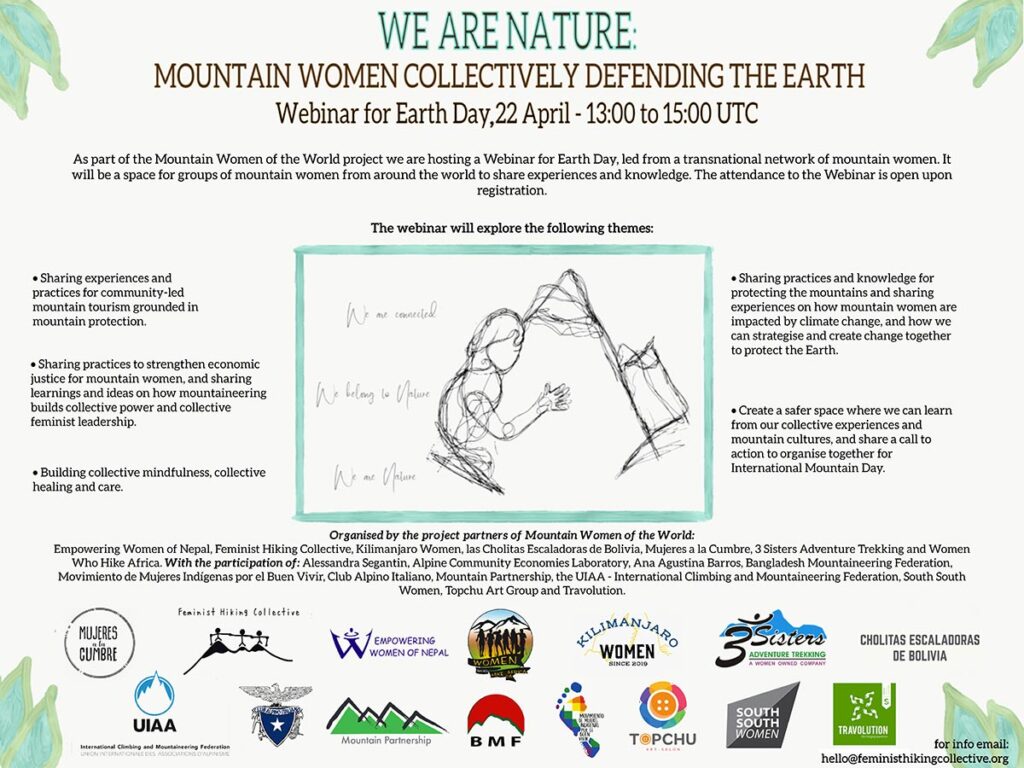
As part of the Mountain Women of the World project, a dedicated Webinar is being launched on Earth Day (22 April), led by a transnational network of mountain women. It will be a space for groups of mountain women from around the world to share experiences and knowledge. The attendance to the Webinar is open for registration.
The UIAA will be represented by three members of its Mountain Protection Commission, Dr Carolina Adler (New Zealand), Professor Harshwanti Bisht (India) and Aupar Ahmed (Bangladesh).
The Webinar, to be held from 13:00 to 15:00 UTC, is organised by the project partners of Mountain Women of the World: Empowering Women of Nepal, Feminist Hiking Collective, Kilimanjaro Women, Mujeres a la Cumbre, Cholitas Escaladoras de Bolivia, 3 Sisters Adventure Trekking and Women Who Hike Africa. With the participation of: Mountain Partnership, the UIAA – International Climbing and Mountaineering Federation, Travolution, Italian Alpine Club, Bangladesh Mountaineering Federation, South South Women, Alessandra Segantin, Ana Agustina Barros and Gender Responsible Tourism.
The Webinar will cover the following themes:
Sharing skills and practices for sustainable mountain development and community-based tourism.
Sharing advice and ideas to strengthen economic justice for mountain women and sharing skills and practices on how mountaineering builds women’s collective power and collective feminist leadership.
Building collective mindfulness and radical healing.
Sharing practices and knowledge for protecting the mountains’ environment, including on ‘leave no trace’ and water protection, and sharing experiences on how mountain women are impacted by climate change and how we can strategise to create change together for climate justice.
Create a safer space and a space where we can learn from our collective experiences and mountain cultures, and share a call to action to organise together for International Mountain Day, with a focus on sustainable mountain tourism.
A number of UIAA member associations have recently announced the election of new Presidents.
Brazil, CBME, Brazilian Mountaineering and Climbing Confederation: Mr Marcio Hoepers succeeds Ms Kika Bradford as new President. Mr Hoepers brings considerable experience working with local federations in Brazil.
Denmark, DKK, Danish Alpine Club, Mr Mitchell Jagd is the federation’s new President, replacing Mr Morten Damkjær Nielsen.
Kazakhstan, MSCFRK, Mountaineering & Sport Climbing Federation Of The Republic Of Kazakhstan, Mr Alzhan Imashev succeeds Mr Kazbek Valieyv.
Korea, KAF, Korean Alpine Federation: Mr Joong-ho Son is the new President of the UIAA full member association in Korea. He previously held the position of Vice President from 1998-2016. He replaces Mr Yangho Ahn.
Kosovo, Kosovo Mountaineering and Alpinist Federation: Mr Arianit Nikqi has recently succeeded Mr Arben Lila as President of the the UIAA full member in Kosovo.
Lithuania, LMA, Lithuania Mountaineering Association: Mr Arūnas Kamandulis is the new President of the UIAA full member in Lithuania replacing Mr Kestutis Skrupskelis.
Portugal, CNM, Clube Nacional de Montanhismo: Mr Luis Vasconcelos has succeeded Mr Jorge Gabriel Oliveira at the helm of the UIAA full member in Portugal.
Spain, FEDME, Spanish Federation for Mountain and Climbing Sports: After 28 years as President of FEDME, former UIAA Management Committee member Mr Joan Garrigós i Toro retired from the role and has been replaced by Mr Alberto Ayora.
The UIAA thanks all outgoing Presidents for their support and friendship over the course of their tenures. The UIAA wishes all new Presidents every success in their role and looks forward to close collaboration over the coming years.
For further details about UIAA member associations please click here.
Manage Cookie Consent
To provide the best experiences, we use technologies like cookies to store and/or access device information. Consenting to these technologies will allow us to process data such as browsing behavior or unique IDs on this site. Not consenting or withdrawing consent, may adversely affect certain features and functions.
Functional
Always active
The technical storage or access is strictly necessary for the legitimate purpose of enabling the use of a specific service explicitly requested by the subscriber or user, or for the sole purpose of carrying out the transmission of a communication over an electronic communications network.
Preferences
The technical storage or access is necessary for the legitimate purpose of storing preferences that are not requested by the subscriber or user.
Statistics
The technical storage or access that is used exclusively for statistical purposes.The technical storage or access that is used exclusively for anonymous statistical purposes. Without a subpoena, voluntary compliance on the part of your Internet Service Provider, or additional records from a third party, information stored or retrieved for this purpose alone cannot usually be used to identify you.
Marketing
The technical storage or access is required to create user profiles to send advertising, or to track the user on a website or across several websites for similar marketing purposes.