Together with its partners, the International Society of Mountain Medicine (ISMM) and the International Commission for Alpine Rescue (ICAR), the UIAA Medical Commission has established and developed a joint Diploma in Mountain Medicine.
About the UIAA Diploma in Mountain Medicine
Many countries offer regular courses in mountain medicine. The medical commissions (Medcom) of UIAA and ICAR, together with the International Society for Mountain Medicine (ISMM) established minimal requirements for a formal Diploma course in August 1997 (Interlaken, Switzerland). Many course organisers adopted these standards and the resulting Diploma in Mountain Medicine (DiMM) has become a widely respected qualification.

Regulations
The regulations have been updated to reflect developments in mountain medicine, ideas presented at meeting of course organisers in November 2018 and to ensure that the high standard of the DiMM is maintained. The member organisations approved the administrative group to change the regulations at their individual meetings in Kathmandu, Nepal (November 2018). The regulations become effective for new and re-approval applications from January 2019. They were further updated in 2023 and can be downloaded here.
Who Can Qualify?
The Diploma in Mountain Medicine qualification can only be awarded to Health Care Professionals registered with a national professional regulatory body (Physicians, Paramedics, Nurses, etc.). The Diploma in Mountain Medicine cannot be awarded to basic life support personnel (EMT’s, First Responders, First Aid, etc.). Students in the final part of their course can start the course but must be registered prior to award of the full qualification. The course can be divided into different parts appropriate for the organizing country (e.g. summer, winter; basic, specialty etc.) but must include the foundational course syllabus to award a diploma.
This must have a minimal study time (lectures, workshops and practical work) of 120 hours. Course organisers can determine who can attend the course and the speciality offered. In addition, course organisers may seek University status for the course. All courses should have some form of valid theory assessment and demonstration of practical skill with a fail potential.
Candidates should complete and maintain a logbook to demonstrate continuing professional development.
How to Apply
Organisers of mountain medicine courses can apply to endorse their courses with the label of the UIAA, ICAR and ISMM Diploma of Mountain Medicine by requesting a standard application form and sending the course programme to Jason Williams.
Applications are to be English and a separate form is required for specialty modules. The administrative group will discuss the application and the course organiser will be notified of its decision. We will acknowledge receipt of the application within three weeks. We may ask for further details within one month. A definitive answer regarding registration of the course will be given within three months. The course may be approved, rejected with reason(s) or referred to the UIAA and ICAR medical commissions and the ISMM.
FURTHER INFORMATION
More than 3,500 doctors, nurses and paramedics have been trained in these courses until now. There are 23 different courses for mountain medicine throughout the world.
New course organisers are encouraged to discuss with, and invite, members of the UIAA Medcom, ICAR Medcom or ISMM to observe their courses. For new courses, approval is for two years. When a course reapplies for approval, the organiser must provide information on the number of successful and unsuccessful candidates during the previous period and provide an external assessor site visit report. Re-approval is for four years. The names of approved courses, their geographic location, main language and contact email address will be posted on the member organisations’ websites and can be viewed below.
Types of Course
If you are a doctor, paramedic or nurse who would like to take part in a mountain medicine course approved by the UIAA, please contact one of the institutions listed below for details.
Foundation Course (120 hours)
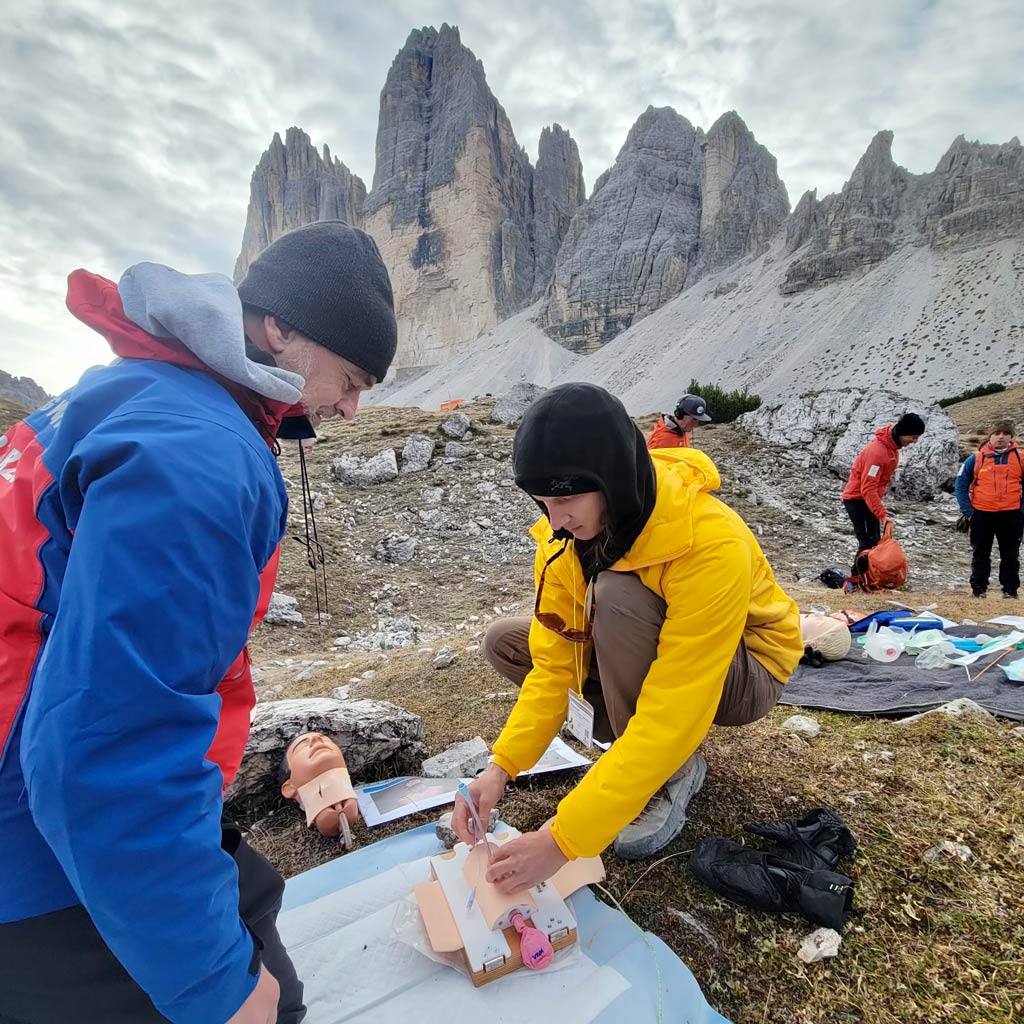
This course covers the recognition, prevention, and management of mountain-specific illness and injury. Participants develop practical competence in both summer and winter mountaineering, including movement over varied terrain, risk assessment, and decision-making in challenging mountain conditions. Combining classroom learning with hands-on field instruction, the diploma establishes a strong foundation for medical professionals seeking to build confidence and capability in mountain medicine.
Specialty Course:
Expedition and Wilderness Medicine (42 hours)
This course is designed for persons going on treks and expeditions with the anticipation that they will be providing medical support.
Specialty Course:
Terrestrial Mountain Rescue (60 hours) & Alpine Helicopter Rescue Specialty Course (53 hours)
These courses are designed for Health Care Professionals who are (or are becoming) members of an organised rescue service. They should have been trained in Advanced Life Support (ALS) and be experienced in mountaineering to an appropriate standard. Curriculum A (Terrestrial Mountain Rescue Specialty Course Module) focuses on terrestrial mountain rescue. Curriculum B (Alpine Helicopter Rescue Specialty Course Module) focuses on air rescue operations in mountainous terrain and should at least attain the minimum standards and regulations of the region or nation. Instructional faculty of the Specialty Rescue Courses must have real-world mountain rescue patient care experience.
Approved DiMM Courses
(*) Please read the following advisory related to the Indian Society for Mountain Medicine and Global Institute of Healthcare Management
| Country | Organiser | Course Provider & Details | Contact |
|---|
Administrative Team
The administrative team makes up the DiMM Regulation and Assessment Committee and is composed of representatives elected by the UIAA, ICAR, and ISMM member organisations and the respective Presidents.